

Key Takeaways
- Registering a company in Singapore is straightforward and can often be done in a day, but only if your business name is approved and your documents are ready.
- Choosing the right business structure from the start is one of your most important decisions. A Private Limited Company (Pte. Ltd.) is the preferred choice for most startups and SMEs because it offers limited liability and greater flexibility for growth.
- Registration is only the beginning. After incorporating, you'll need to meet ongoing legal requirements, such as filing annual returns, maintaining company records, appointing a company secretary, and fulfilling your tax obligations.
Thinking of starting a business in Singapore? This quick guide covers exactly how to register a company in Singapore in 2026, plus everything you need to stay compliant after incorporation.
How To Register a Company in Singapore in 2026
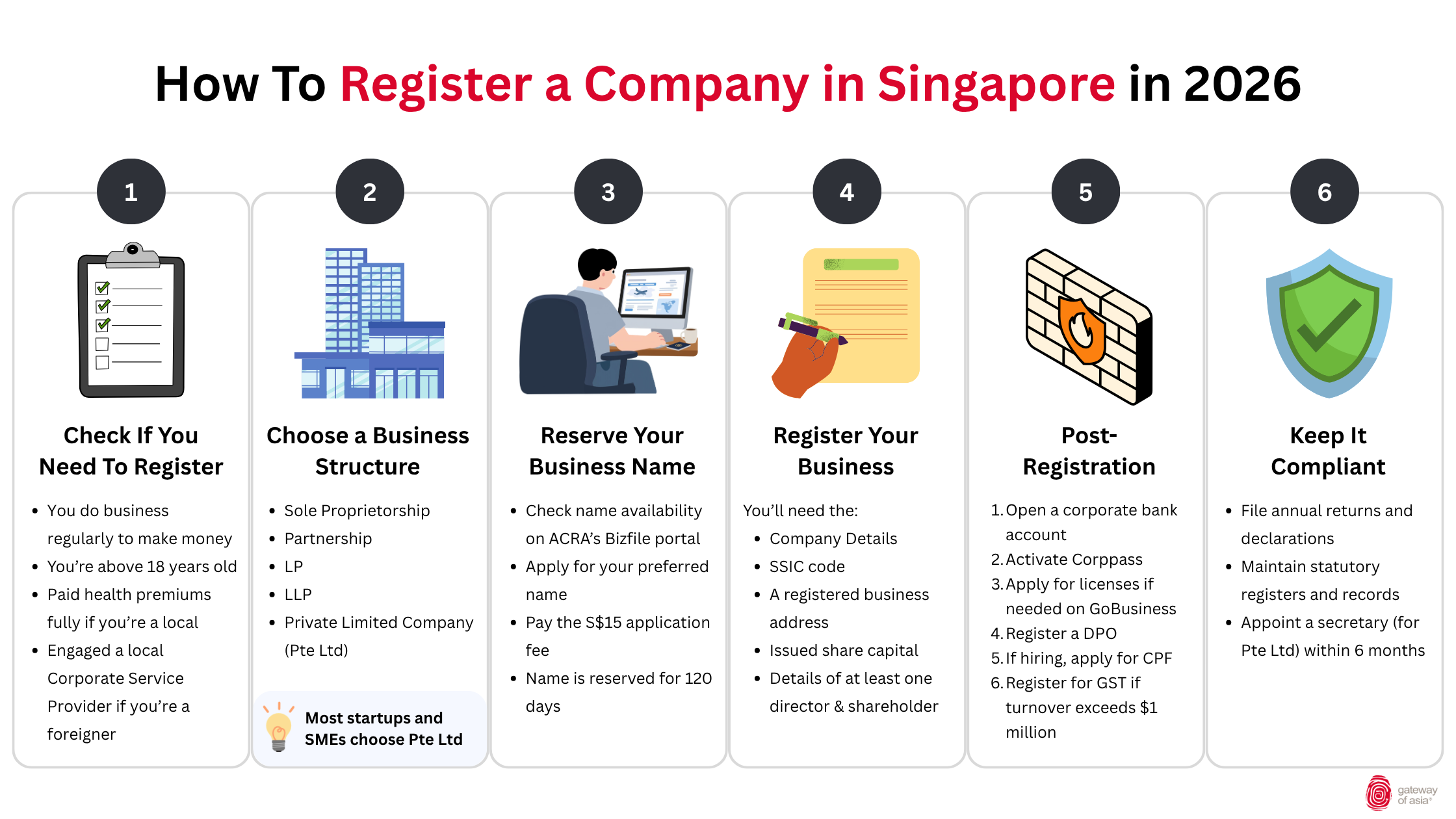
Step 1: Check If You Need to Register
Before anything else, make sure you qualify to register your business.
- You must register if you do any work regularly to make money. This includes online shops, home bakeries, or dropshipping.
- You do not need to register if you use only your real name (like Tan Jun Kit). But if you add any extra words (like Coffee by Tan Jun Kit), you must register.
- You must be at least 18 years old.
- If you're a local, you must pay your health premiums fully before registering.
- If you're a foreigner, you cannot do this alone. You must hire a local Corporate Service Provider like Gateway of Asia to register your company for you.
Step 2: Choose the Right Business Structure
If you've met the registration requirements, the next decision is choosing your Singapore business setup. The right choice depends on your business goals, ownership, and appetite for risk.
Other business structures include:
- Sole Proprietorship: Suitable for individuals running a business alone. The owner and business are legally the same entity, meaning the owner is personally responsible for all debts and liabilities.
- Partnership: Owned by two or more individuals who share profits and liabilities.
- Limited Liability Partnership (LLP): Combines the flexibility of a partnership with limited liability protection for partners.
Tip
Which Business Structure is Right For You?
| Structure | Best for |
|---|---|
| Sole Proprietorship | Freelancers, solo businesses |
| Partnership | Businesses with 2–20 owners |
| Limited Partnership (LP) | Investors with active managers |
| Limited Liability Partnership (LLP) | Professional firms, agencies |
| Private Limited Company (Pte Ltd) | Most startups and SMEs |
If you're still not sure which business structure to pick and want to avoid losing your $300 registration fee, you can consult our corporate services experts at Gateway of Asia for free.
Step 3: Reserve Your Business Name
Now that you've decided on your business setup in Singapore, you need to get your business name approved. You cannot start a business until the government approves your name. Here's how to do so:
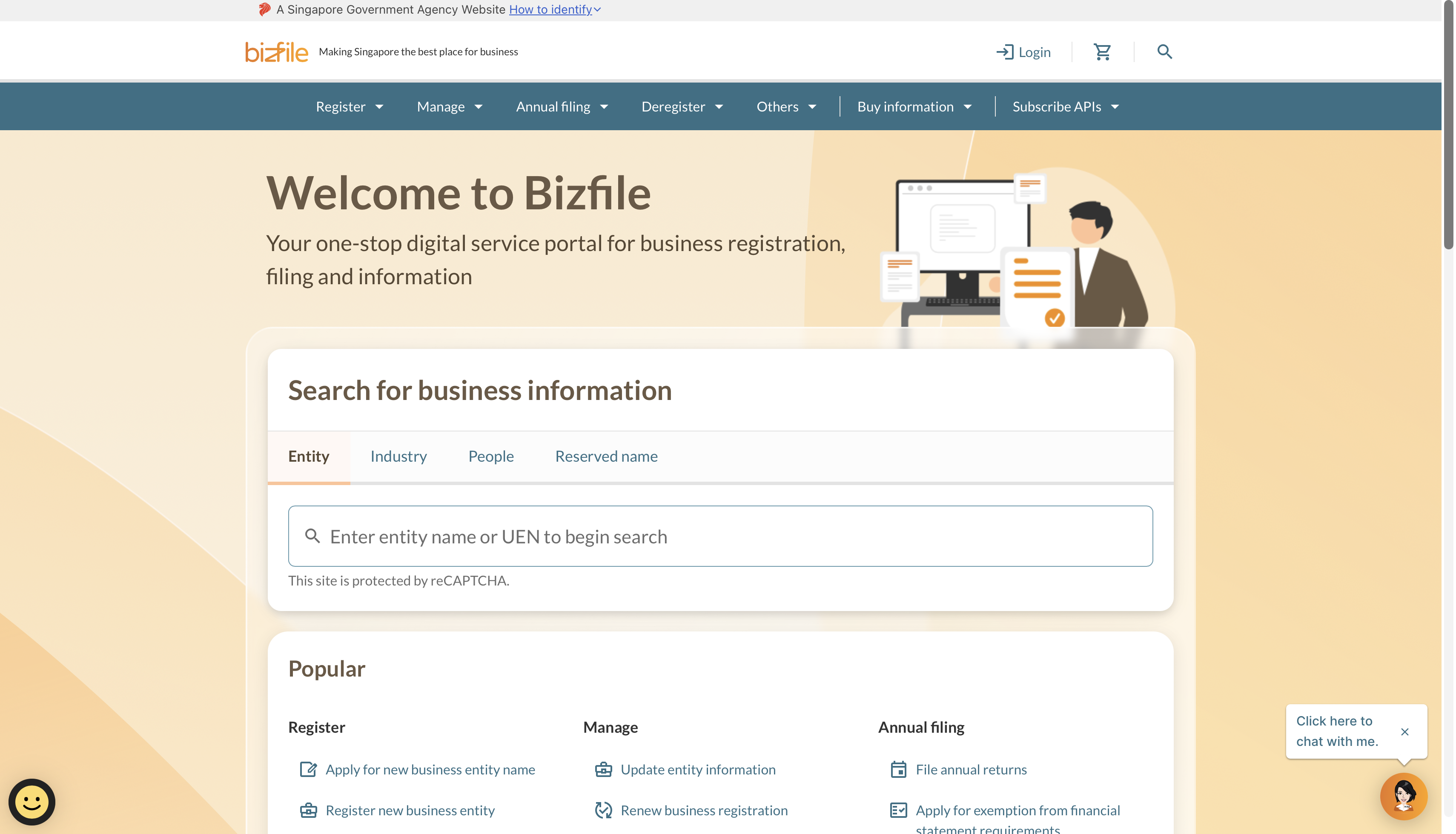
- Visit the ACRA Bizfile Portal.
- Type in your preferred business name in their tool to see if anyone is already using it.
- Click Login at the top right and use your Singpass to log in.
- Go to the menu and select Apply for New Business Name.
- Type your chosen name, select your business type, and choose a 5-digit SSIC Code (a code that describes your business activity, like "Retail").
- Pay the $15 fee using a credit card or online banking.
Most names are approved instantly. Once approved, the name is locked for you for 120 days. You must finish the next step before this time runs out.
Tip
Step 4: Register the Business
Once your name is approved, you can officially register your business! To quicken the process, prepare these information beforehand:
- Company Details
- Approved business name
- Principal business activity (the same SSIC code you used to reserve your name)
- A registered business address (that is not a P.O. box)
- Issued share capital (Minimum $1)
- Details of at least one director and one shareholder. They can be the same person. At least one director must be a Singapore Citizen, Permanent Resident, or EntrePass/Employment Pass holder. You'll need their full name, identification number or passport number, residential address, and consent to act as director.
- Company Constitution (Most new businesses adopt ACRA's Model Constitution.)
Tip
Now that you have all the information you need, here's how to register:
- Log into the ACRA Bizfile Portal using your Singpass.
- Select "Register new business entity" from the main dashboard.
- Type in your approved business name transaction number.
- Fill in all your business details.
- Check the declaration box to confirm your details are true, click Submit, and pay $100 for a Sole Proprietorship/LLP or $300 for a Private Limited Company.
Once approved, you will find a Notice of Successful Incorporation, your Unique Entity Number (UEN), and a link to download your free Business Profile in your BizFile inbox.
Step 5: What to Do Right After Registration
Once your business is registered, there are a few common operational tasks to complete before you can start selling.
- Open a Corporate Bank Account: Do this immediately to separate personal and business expenses. Major options include DBS, OCBC, UOB, and digital banks like ANEXT.
- Activate Corppass: This is your corporate login for all government transactions. Set it up one day after getting your UEN.
- Check for Licences: Head to the GoBusiness portal and type in your business type (like "Restaurant" or "Clinic") to see if you need special operational permits before you start selling.
- Register a Data Protection Officer (DPO): Mandated for all organizations under the PDPA, you need to register your DPO on the PDPC website.
- Employer Requirements: If you are hiring staff, visit the CPF Board Portal to apply for a CPF Submission Number so you can pay their monthly pension funds.
- Understand Your Tax Filing & GST Obligations: If your business makes more than $1 million, you must visit the IRAS myTax Portal to register for GST tax.
These are the most common post-registration steps for new businesses. Depending on your business structure, industry, and operations, you may not need to complete every item, or you may have additional requirements to meet.
Step 6: Keeping Your Business Compliant
Congratulations, you're now a business owner in Singapore! Now comes the part many first-time entrepreneurs overlook: staying compliant. Depending on your business structure, you'll have different legal obligations to fulfil throughout the year.
If you registered a Private Limited Company
- Appoint a company secretary
- Appoint an auditor (if not exempt)
- Maintain statutory registers
- Hold Annual General Meetings (where required)
- File annual returns
If you registered an LLP
- Maintain accounting records
- Keep a Register of Registrable Controllers (unless exempt)
- File annual declarations
If you registered a Sole Proprietorship, Partnership or LP
- Renew your company registration in Singapore every 1 or 3 years
- Ensure required Medisave contributions remain up to date (where applicable)
Missing compliance deadlines can lead to late filing penalties, regulatory action, or, in some cases, the cancellation or striking off of your business registration. While the requirements vary depending on your business structure, staying organised or engaging a corporate services provider can make compliance much more manageable as your business grows.
Frequently Asked Questions
How long does it actually take to register a company in Singapore?+
Should I register my company myself or use a Corporate Service Provider?+
What is the total cost to register a company?+
Is a Pte. Ltd. always better than a Sole Proprietorship?+
Can I use my home address as the business address?+
Can a foreigner own 100% of a Singapore company?+
Do I need a company secretary immediately?+
When do I need to register my business for GST?+
Do I need an auditor?+
Can I start selling immediately after getting my UEN?+
Can a Corporate Service Provider help after my company is registered?+
What is the biggest mistake new business owners make?+
What happens if I stop operating the business?+
Conclusion
Now that you know how to register a company in Singapore, it's time to build your business. Long-term success comes from staying compliant, managing your finances well, and continuously growing your business.
While many entrepreneurs choose to handle the registration themselves, there's no need to navigate everything alone. Whether you need help deciding on the right business structure, registering your company, or staying on top of annual compliance, working with an experienced Corporate Service Provider can save you time and reduce the risk of costly mistakes.
Start your Singapore company with Gateway of Asia
From choosing the right structure to filing your first annual return, our team handles every step so you can focus on building. Talk to us and get your incorporation done right — the first time.
Talk to our team →About Gateway of Asia
Gateway of Asia is an award-winning corporate services partner in Singapore helping local and foreign business owners scale safely with tailored solutions in incorporation, secretarial, tax, accounting, and operations, with a proven history of supporting over 1,000+ companies across 30+ countries.