
If you run a private limited company (Pte. Ltd.) in Singapore, there are two pieces of paperwork you can't ignore every year: your Annual Return (AR) with ACRA and your tax filing with IRAS. Miss either one and directors, not just the company, can be personally fined or even disqualified. This guide will focus on how to file Annual Return, covering:
- Who has to file an annual return, and when
- What to prepare before you file
- The step-by-step annual return filing process
- What happens if you're late, and how to apply for an extension
What exactly is an Annual Return?
An Annual Return is an online form filed with ACRA through the Bizfile+ portal. Think of it as your company's yearly "proof of life and accuracy" check. It confirms that ACRA's public record of your company is still correct. The form covers things like:
- your company name
- registration number
- business activities
- registered office address
- details of directors and the company secretary
- information about shareholders and share capital
- financial statements where required
You will see this before you can start to file your Annual Return on BizFile+:
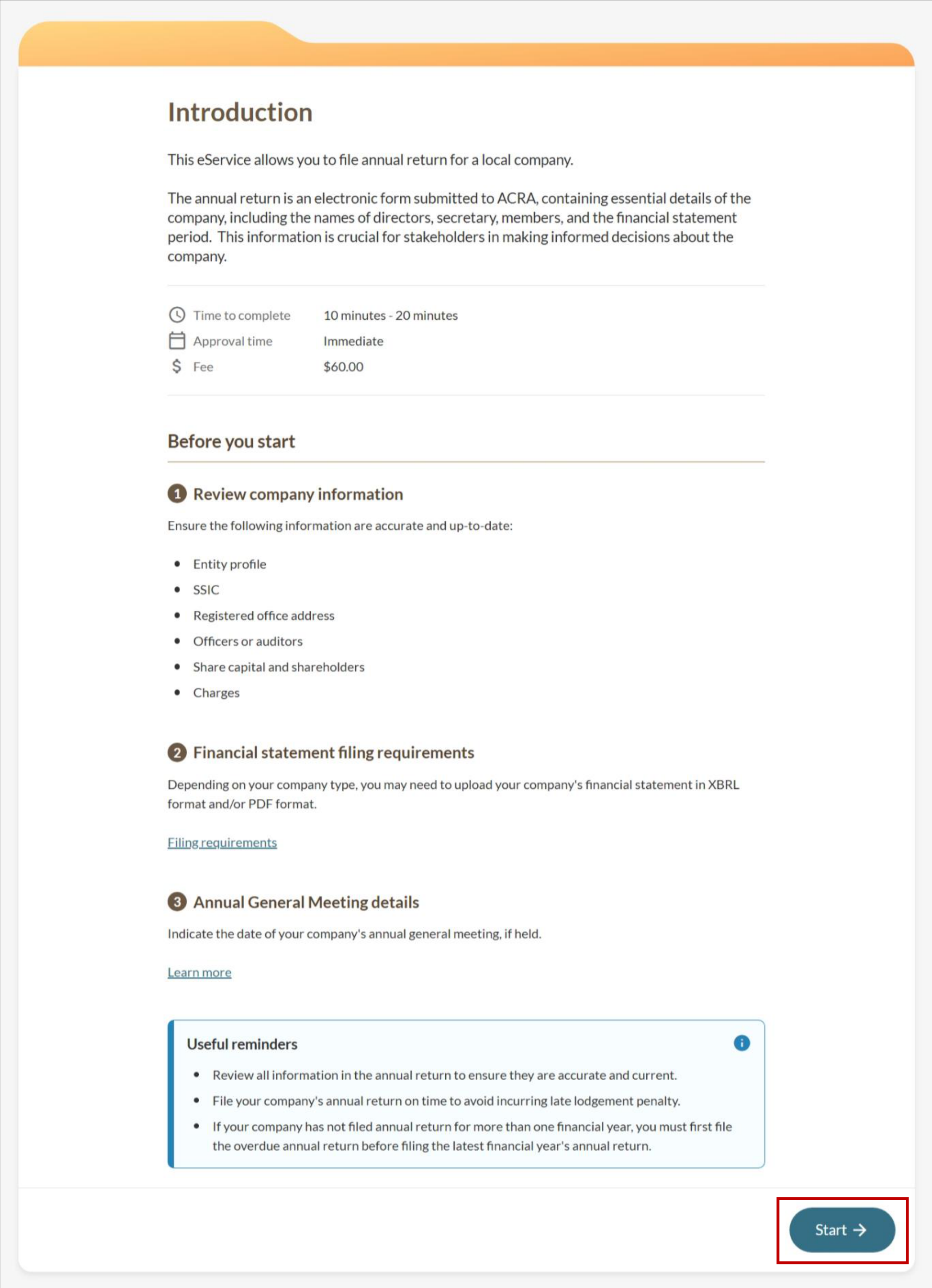
The purpose of filing an annual return with ACRA is so that stakeholders like investors, banks, and business partners can trust that your information on the public register is current and up-to-date.
Unlike a sole proprietorship or partnership, a private limited company is legally its own "person," separate from you. ACRA's register is basically its public profile. Keeping that profile accurate even after registering your company is part of the trade-off for the liability protection and credibility a Pte. Ltd. structure gives you.
Key Takeaways
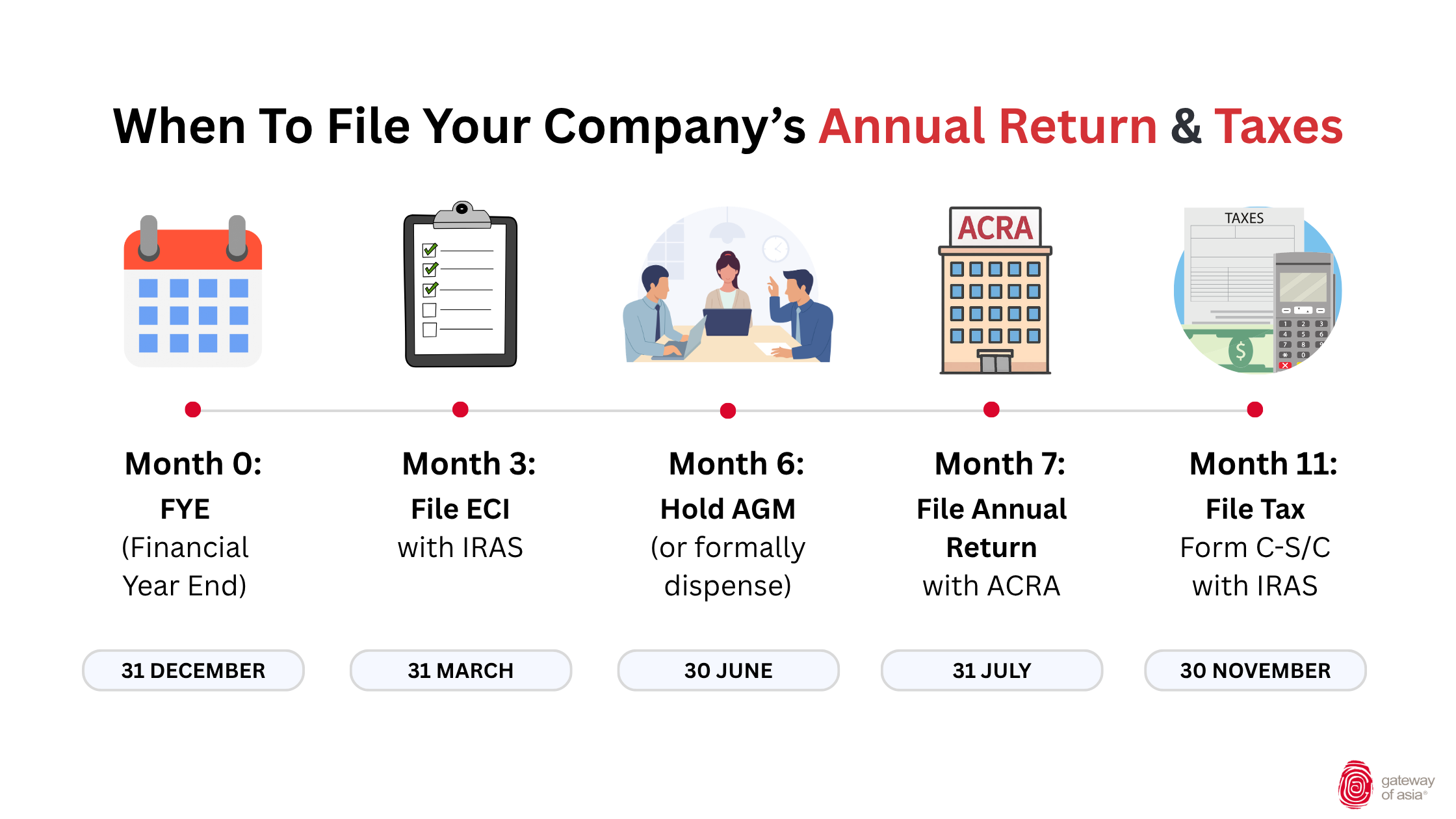
- Prepare financial statements (SFRS), which is the basis for everything below.
- Hold an AGM (or formally dispense with it), within 6 months of FYE.
- File Annual Return with ACRA, within 7 months of FYE at S$60.
- File ECI with IRAS, within 3 months of FYE (unless waived if revenue ≤ S$5M and ECI is nil).
- File Form C-S / C-S Lite / Form C with IRAS by 30 November every year.
- File GST returns quarterly, only if GST-registered.
Did you know?
Who has to file an annual return?
Every company incorporated in Singapore. If your company is registered in Singapore and its status on ACRA's register is "live," you or your corporate service provider must file annual return with ACRA every year, even if the company:
- Is inactive or dormant
- Has been granted a tax waiver by IRAS
- Has no revenue or business activity for the year
This applies whether you're a standard private company limited by shares, an Exempt Private Company (20 or fewer individual shareholders and no corporate shareholder), or a public company limited by guarantee. The obligation only stops if a company is formally struck off (removed from ACRA's register) or formally wound up (liquidated and dissolved).
Only entities outside the "company" structure like sole proprietorships, partnerships, and LLPs aren't required to file an AR at all. They renew registration instead.
When is your Annual Return due?
If you run a typical private limited company that is not listed on the stock exchange and has no overseas branch, you have 7 months after your financial year ends to file Annual Return through ACRA.
So if your financial year ends 31 December, your annual return filing deadline is 31 July the following year. That's the number to circle on your calendar.
But if your company is:
- Listed on a stock exchange (like SGX)? You only get 5 months, not 7.
- Have an overseas branch register on top of share capital? Add 1 extra month to whichever deadline applies to you (6 months if listed, 8 months if not listed).
One important thing to note is that once your deadline passes, you can't go back and change your financial year end to buy yourself more time. The deadline locks in the moment it lapses, so it's worth marking it early rather than figuring it out after the fact.
Want to free up your time to focus on growing your business?
Let a corporate service provider with 30+ years of experience file your Annual Return, taxes, and more. Drop us a message and we'll let you know what works best for you.
Talk to our team →What you need before you start to file annual return
We recommend checking the following before you log in to file your AR:
- Make sure company details are current: registered office address, business activities (SSIC codes), and particulars of directors and the company secretary. You're legally required to keep this information accurate, and any errors need to be corrected via the "Update entity information" eService before you file the AR.
- Confirm shareholder and share information: number of shares held, issued share capital, and paid-up capital, including any transfers or allotments made during the year.
- Whether you need to file financial statements, and in what format. Most private limited companies need to submit these in XBRL format via the BizFinx tool, unless they're exempt (for example, some solvent Exempt Private Companies).
- Your AGM details. You must declare these regardless of whether you actually held an Annual General Meeting, were exempt from one, or dispensed with it by written resolution.
- Director sign-off. A company with only one director needs that director's signature on the directors' statement. Companies with multiple directors need at least two signatures.
How do I file an annual return for my company in Singapore?
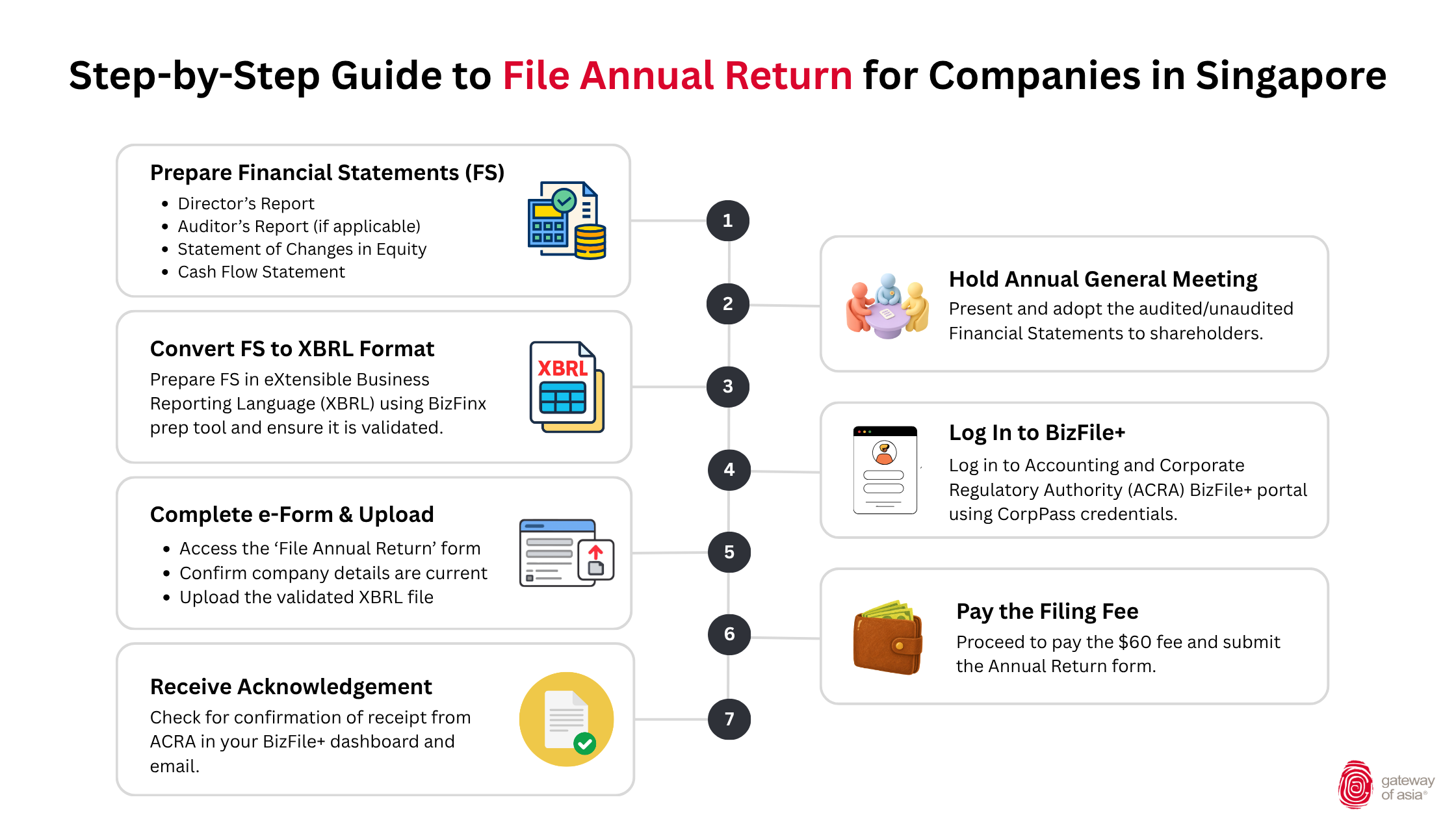
Follow these 5 steps to file your company's AR:
- Log in to Bizfile+ via Corppass, using Singpass to verify your identity, then open the "File annual returns" ACRA eService.
- Review your entity information: company type, FYE, and other registered details are pre-filled from your last filing, so you're mainly checking for accuracy and updating anything that's changed.
- Complete the declaration relevant to your company type. The form branches depending on whether you're an Exempt Private Company, a private company limited by shares, a public company, or another structure, and whether the company was active or dormant during the year. You'll be asked about solvency and whether you qualify for audit exemptions.
- Fill in AGM and financial statement details. Enter your AGM date (or the date financial statements were sent to members, if exempt from an AGM), and attach your XBRL financial statements or a PDF copy if XBRL isn't required.
- Review and submit. Check everything on the confirmation page, tick the declaration checkbox, and pay the filing fee.
The filing fee is a flat S$60, and once payment goes through, your company's record updates immediately. There's no waiting period for approval. You'll also receive a free electronic Business Profile after filing, though it's only downloadable for 60 days before the free copy expires.
What happens if you file your company's Annual Return late?
This is where a lot of companies get caught out, because the consequences escalate quickly:
- Late lodgment penalty: S$300 if filed within three months of the deadline, rising to S$600 if it's more than three months late. This is applied automatically the moment you submit.
- Composition sum: For more serious or combined breaches (for instance, a late AGM plus a late AR), ACRA may offer a composition sum, often at least S$500 per breach, to settle the matter without going to court.
- Court prosecution: If a composition isn't accepted or offered, or if there's a pattern of repeated late filing, ACRA can prosecute the company and its directors. A conviction can carry a fine of up to S$10,000 per charge.
- Striking off: Under section 344(1) of the Companies Act, ACRA can strike a company off its register if it has reasonable cause to believe the company isn't carrying on business, and persistent AR non-filing is a common trigger. Companies get a Striking Off Notice, 30 days to object, then a First Gazette Notification, and finally (60 days later, absent objection) a Final Gazette Notification that removes the company from the register entirely.
- Director disqualification or debarment: Directors convicted of three or more filing offences within five years face a five-year disqualification. Having three or more companies struck off within five years brings a three-year disqualification (five years for repeat cases). Debarred directors can't take on new director or company secretary roles anywhere.
If you think a penalty is unfair or want more time before your court date, you can submit the ACRA Late Lodgment Appeal Form with supporting documents. Appeals typically take about four weeks to review.
Need more time with AR filing? You can apply for an extension
If you know in advance you won't make the annual return filing deadline, ACRA allows a 60-day extension of time (EOT) to file your AR, at a cost of S$200 per application. This has to be requested before the deadline passes. It's not something you can apply once you're already late.
The bottom line
Filing your Annual Return is a routine, once-a-year task, but it's one where missed deadlines can turn into penalties or even a striking-off notice if it drags on. The safest approach is simple: know your FYE, mark your annual return filing deadline the day your financial year closes, keep your company records (directors, shareholders, address) updated year-round, and use Bizfile+'s pre-filled form to your advantage since most of the heavy lifting is already done for you.
Take the compliance calendar off your plate
If juggling your annual return, tax submission, accounting and bookkeeping on top of actually running your business sounds like a lot, a corporate service provider like us can handle it end to end. Speak to us and we'll guide you through any questions you may have.
Talk to our team →About Gateway of Asia
Gateway of Asia is an award-winning corporate services partner in Singapore helping local and foreign business owners scale safely with tailored solutions in incorporation, secretarial, tax, accounting, and operations, with a proven history of supporting over 1,000+ companies across 30+ countries.